If you’re serious about mobile gaming in 2026, you already know that not all phones are equal. A phone that claims “120Hz display” and “flagship chipset” might still give you frame drops, screen dimming, and hot hands after 20 minutes of BGMI or Call of Duty. Why? Because gaming phones need more than just raw power. They need smart cooling, sustained performance tuning, responsive touch sampling, and battery tech that doesn’t give up mid-match.
The Indian mobile gaming scene is massive. From BGMI and Free Fire to Call of Duty Mobile and Genshin Impact, lakhs of players game daily on phones. But most “flagship” phones are designed for general use – they peak fast, then throttle to save battery life or reduce heat. True gaming phones are built differently. They prioritise consistent frame rates even if it means slightly lower peak performance.
In this guide, we’ll explain everything you need to look for in a gaming phone under different budgets in 2026. We’ll cover processors, cooling systems, display touch response, battery bypass charging, and software features that matter. No marketing fluff – just practical advice for Indian gamers who want a phone that doesn’t let them down during the last circle. Prices and offers change, so always check current deals before buying.
Quick Summary
- The best gaming chipset in 2026 for sustained performance is Dimensity 9400, closely followed by Snapdragon 8 Elite with good cooling.
- Cooling system matters more than chipset – look for vapour chamber size (4000mm²+) and graphite layers.
- Display touch sampling rate (1000Hz+ instant touch) is more important for competitive gaming than peak brightness.
- Bypass charging is a must-have for long gaming sessions – it powers the phone directly, saving battery health and reducing heat.
- 6000mAh batteries are becoming common in gaming phones – aim for at least 5500mAh with 65W+ charging.
Why This Gaming Phone Guide Matters
In 2026, you don’t need to spend ₹80,000 on a dedicated “gaming phone” like the ROG Phone or RedMagic. Many regular flagships and performance-focused mid-rangers now offer excellent gaming capabilities. However, the difference between a phone that feels great for gaming and one that frustrates you often comes down to thermal design and software tuning – things that aren’t obvious on a spec sheet.
Indian summers are brutal for phone gaming. Ambient temperatures of 35-40°C mean that a phone that throttles at 45°C will start dropping frames within 10 minutes. A well-cooled phone might keep full performance for 40 minutes. That’s the difference between winning and losing. Also, mobile esports is growing – if you play competitively, even 5ms of extra touch latency can cost you a match.
This guide will help you separate true gaming phones from “gaming-looking” phones with RGB lights and fake vents. We’ll explain what to compare and what to ignore.
Key Features or Main Points
Here are the five pillars of a great gaming phone in 2026. Use these to compare any device before buying.
1. Processor and Sustained Performance
The chipset is the engine, but how it’s tuned matters more than peak specs. For 2026, the top gaming chips are Snapdragon 8 Elite, Dimensity 9400, and Snapdragon 8s Gen 4 (for budget gaming). All can run any game at max settings. However, sustained performance – after 30 minutes – varies widely.
Dimensity 9400 generally runs 2-3°C cooler under load, which means less throttling. Snapdragon 8 Elite can reach higher peak frame rates but needs excellent cooling to maintain them. For most Indian gamers, a Dimensity 9400 phone with a large vapour chamber will give the most consistent experience. Avoid older chips like Snapdragon 8 Gen 1 or Dimensity 8100 – they run hot and don’t support the latest gaming features like hardware-accelerated ray tracing.
Also check for “game mode” software features that allow you to lock the CPU frequency or prioritise GPU performance. Some phones let you disable thermal throttling – use with caution as it can shorten battery lifespan.
2. Cooling System – The Most Overlooked Spec
This is the single biggest differentiator between a good gaming phone and a bad one. A phone with a small or no vapour chamber will heat up quickly, then dim the screen and drop frame rates to protect internal components.
What to look for: Vapour chamber surface area (aim for 4000mm² or more), multiple graphite layers, and thermal gel or paste. Some phones even have built-in fans (like RedMagic) or external fan attachments (ROG Phone). In 2026, the best cooling designs use a “thermal runway” architecture – copper vapour chamber covering both CPU and modem, plus a layer of graphene on the display side.
Real-world test: Check YouTube reviews where they measure surface temperature after 30 minutes of Genshin Impact at max settings. Anything above 48°C on the back is too hot. Also check if the phone throttles – does the frame rate drop from 60 to 45fps? A good gaming phone will stay within 5% of peak performance.
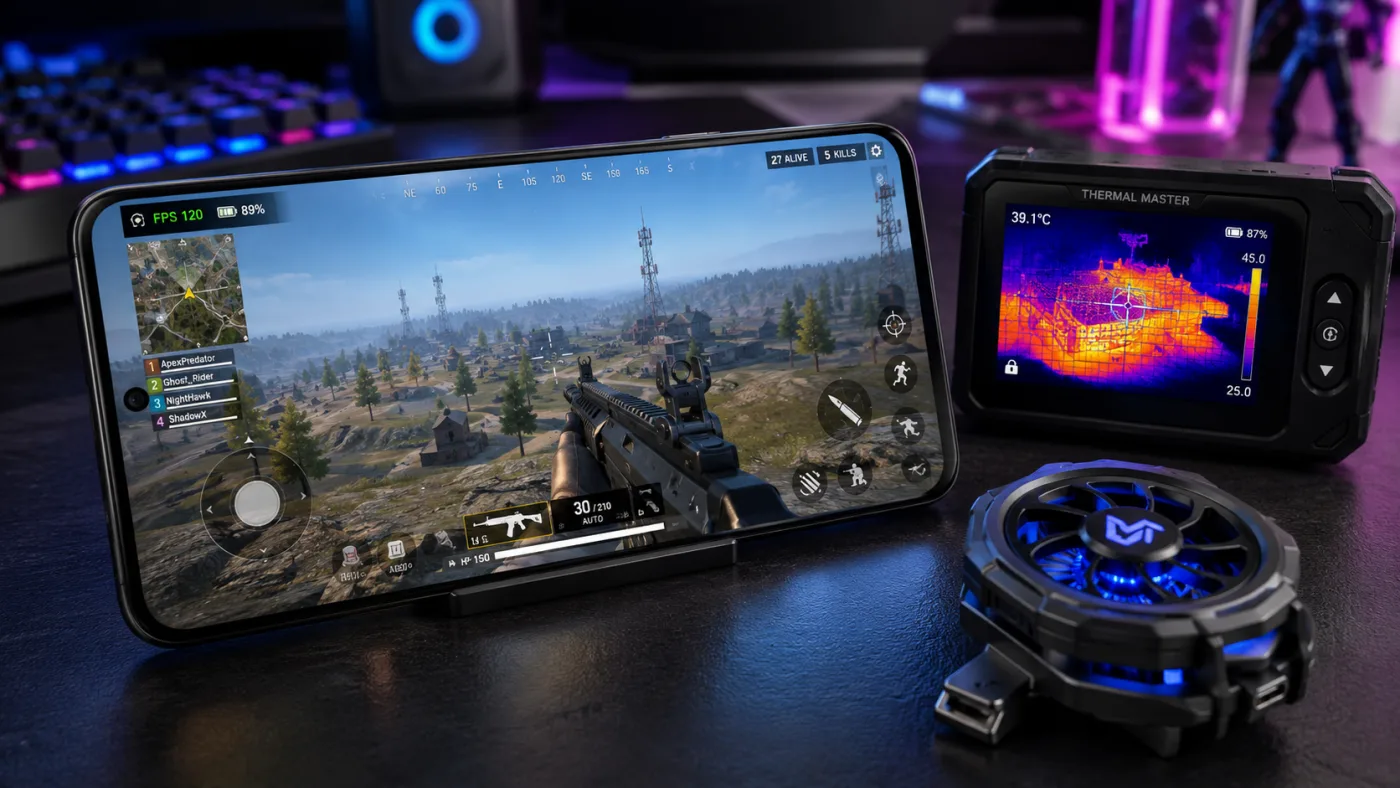
For Indian buyers, consider buying a clip-on cooling fan (available for ₹1,500-₹3,000) if you play for more than an hour daily. It dramatically improves performance and battery health.
3. Display – Refresh Rate vs Touch Sampling Rate
Most buyers look only at refresh rate (120Hz, 144Hz, 165Hz). But for competitive gaming, touch sampling rate is equally important. Touch sampling rate is how often the screen checks for your finger. A higher rate means lower input lag – crucial for shooters like BGMI.
In 2026, good gaming phones offer at least 480Hz touch sampling rate, while excellent ones go up to 1000Hz or 1500Hz instantaneous sampling. Refresh rate of 120Hz is the sweet spot – 144Hz and above are nice but most games don’t support beyond 120fps. Make sure the display has an AMOLED or LTPO panel with fast response time (<1ms). Avoid IPS LCD for gaming – ghosting is visible.
Also look for: flat display (curved screens cause accidental touches), high peak brightness (>1300 nits for outdoor gaming), and a hole-punch camera that doesn’t interfere with touch zones. Some gaming phones use an under-display camera for a full screen – that’s ideal.
Don’t fall for “HDR10+ gaming” marketing – most mobile games don’t support HDR properly. Focus on touch latency and colour accuracy.
4. Battery Capacity and Bypass Charging
Gaming drains battery fast. A normal 5000mAh phone might give 4-5 hours of gaming. A gaming phone should offer 5500mAh to 7000mAh for 6-8 hours of continuous play. Brands like ASUS and Xiaomi now offer 6000mAh+ batteries in gaming-focused models.
But even more important than capacity is bypass charging. This feature allows you to plug in the charger and power the phone directly, bypassing the battery. Why does that matter? Because charging while gaming generates massive heat – both from the chip and the battery. That heat causes throttling and degrades battery health rapidly. With bypass charging, the battery isn’t being charged or discharged during gaming – it just sits idle. The phone stays cooler, and your battery lasts years longer.
Almost all dedicated gaming phones (ROG, RedMagic, iQOO) have bypass charging. Some regular flagships now include it too. If you game while plugged in, do not buy a phone without this feature.
Fast charging speed matters less for gamers because you’ll often play while charging. 65W+ is good, but 100W+ is overkill. Also check if the phone supports “charging separation” – a software toggle to stop charging at a certain percentage (e.g., 80%) to prolong battery life.
5. Software Gaming Features and Audio
Beyond hardware, software makes a huge difference. Look for these features in a gaming phone:
Game Space / Game Center: A dedicated interface where you can adjust performance profiles, block notifications, and monitor temperature and FPS.
Shoulder triggers / touch-sensitive zones: Many gaming phones have ultrasonic or capacitive shoulder buttons (like ROG Phone’s AirTriggers). They give you extra buttons without a controller. Even without physical triggers, some phones offer on-screen touch zones that can be mapped to actions.
Audio latency and quality: For shooters, directional audio is critical. Look for dual stereo speakers (not just one bottom speaker) and support for aptX Adaptive or LDAC if you use wireless earbuds. A 3.5mm headphone jack is still appreciated by serious gamers – no Bluetooth latency.
Network optimisation: Features like Wi-Fi/5G intelligent switching, low-latency mode, and call blocking during games are useful. Also check if the phone supports dual Wi-Fi (2.4GHz + 5GHz) for better stability.
No ads in games: Some brands show ads even in game mode. Avoid them. Stick with iQOO, ASUS, or flagship OnePlus for clean gaming software.
Real-World Buying Advice
Now that you know what matters, here’s how to choose the best gaming phone for your budget in India for 2026.
Budget under ₹25,000: Look for phones with Snapdragon 7+ Gen 4 or Dimensity 8300. These can handle BGMI at 90fps (smooth) for 30+ minutes if the cooling is decent. Realme Narzo 70 Pro or Poco X7 Pro are good options. Don’t expect 120fps or bypass charging at this price. Prioritise a 120Hz AMOLED display and at least 5000mAh battery.
Budget ₹30,000-₹45,000: This is the sweet spot for value gaming. Look for Snapdragon 8s Gen 4 or Snapdragon 8 Gen 2 (older but still good) with a large vapour chamber. iQOO Z10 Pro, OnePlus Nord 5, and Poco F6 are strong contenders. Some may offer 120fps in BGMI. Ensure touch sampling rate is 480Hz+.
Budget ₹45,000-₹70,000: True gaming phone territory. Here you should demand a flagship chip (Dimensity 9400 or Snapdragon 8 Elite), 6000mAh battery, bypass charging, and at least 1000Hz touch sampling. iQOO 13, ROG Phone 9, and RedMagic 10 are top picks. Also look for shoulder triggers and a 3.5mm jack.
Budget ₹70,000+: At this point, you’re getting the absolute best – 165Hz displays, built-in cooling fans, 7000mAh batteries, and aggressive tuning. Only buy if you’re a competitive esports player or a tech enthusiast. For most gamers, the ₹45K-₹70K range offers 95% of the experience for half the price.
General tips: Never buy a gaming phone without watching a thermal performance review. Check if the phone throttles in 35°C ambient temperature – some reviewers simulate Indian conditions. Also, buy a good case that doesn’t trap heat – many “rugged” cases make throttling worse. Finally, consider buying a magnetic cooling fan for extended sessions.
Who Should Buy a Dedicated Gaming Phone?
- Competitive BGMI/Call of Duty players who play ranked matches daily for 2+ hours.
- Streamers who game and stream simultaneously – need sustained performance and good cooling.
- People who play demanding titles like Genshin Impact or Warzone Mobile at max settings.
- Users who hate charging mid-day and want 6000mAh+ batteries.
- Those who play with a controller – gaming phones often have better controller mapping and low latency.
Who Should Avoid a Dedicated Gaming Phone?
- Casual gamers who play Candy Crush or Ludo – a regular mid-range phone is more than enough.
- People who prioritise camera quality – gaming phones have average cameras (they cut costs on sensors).
- Users who want a slim, lightweight phone – gaming phones are thick and heavy (210g+).
- Those who need waterproofing and wireless charging – many gaming phones skip these to add cooling.
- Budget buyers under ₹20,000 – at that price, a regular phone with a decent chip is fine; dedicated gaming phones start higher.
Comparison Angle
When comparing two gaming phones, ignore marketing names like “Ultra Gaming Mode”. Instead, compare these measurable factors:
Sustained frame rate: Look for reviews that show FPS over time graphs. A phone that holds 90fps for 40 minutes is better than one that hits 120fps for 10 minutes then drops to 70fps.
Surface temperature: Compare back panel temperatures after 30 minutes. Anything above 48°C is uncomfortable. Above 52°C is dangerous for battery health.
Display touch latency: Some reviewers measure touch-to-photon latency (in ms). Below 40ms is excellent for competitive gaming.
Battery discharge rate per hour of gaming: A 5000mAh phone might drain 25% per hour; a 6000mAh might drain 18%. Calculate total gaming time.
Charging speed while gaming: Test if the phone supports fast charging while playing – some phones slow charge to 10W when screen is on. Bypass charging solves this.
Fan noise (if built-in): RedMagic’s fan spins at 20,000rpm – it’s audible. Decide if you prefer silence or cooling.
Software update support: Gaming phones from ASUS and iQOO get 3+ years of updates. Some niche brands like RedMagic give only 2 years. That matters for long-term security.
Final Verdict
The best gaming phone in 2026 isn’t the one with the highest AnTuTu score – it’s the one that gives you consistent performance without burning your hands. For most Indian gamers, the iQOO 13 (or its successor) offers excellent cooling, bypass charging, and a 144Hz display at a reasonable price (around ₹50,000). If you have a tighter budget, the Poco F6 or OnePlus Nord 5 are great value. If you’re a hardcore enthusiast and money is no object, the ASUS ROG Phone 9 or RedMagic 10 will give you every feature you could want.
But remember: even the best gaming phone will struggle if you play under direct sunlight in 40°C weather without a cooling fan. Manage your expectations, use a fan for long sessions, and take breaks to let the phone cool. Most importantly, use NXTrendz Compare to compare real specs and user reviews before buying. Prices and offers change, so check current deals and bank discounts before clicking purchase.
Game on, but game smart.
Frequently Asked Questions
Is a dedicated gaming phone worth it over a flagship like Samsung S25 Ultra?
For pure gaming, yes. The Samsung S25 Ultra has a great chip but throttles more aggressively due to its slim design. Gaming phones offer larger batteries, better cooling, bypass charging, and shoulder triggers. However, if you take photos often, a flagship is better all-rounder. Choose based on your primary use.
Which phone gives 120fps in BGMI in 2026?
Many phones support 120fps now, but consistent 120fps requires a Snapdragon 8 Elite or Dimensity 9400 with excellent cooling. Models like iQOO 13, ROG Phone 9, and RedMagic 10 are confirmed. However, BGMI’s server-side frame rate caps may vary – check official compatibility list.
Does mobile gaming reduce phone battery life permanently?
Yes, but bypass charging dramatically reduces degradation. If you game daily for hours without bypass charging, your battery may lose 20% capacity in 18 months. With bypass charging, that drops to 5-10%. Also, avoid charging to 100% – stop at 80% for longer lifespan.
What is the best budget gaming phone under ₹25,000?
In 2026, the Poco X7 Pro (Dimensity 8300) and Realme Narzo 70 Pro (Snapdragon 7+ Gen 4) are top picks. Both offer 120Hz AMOLED, 5000mAh+ batteries, and decent cooling. You won’t get bypass charging or 120fps, but 90fps is smooth.
Should I buy a phone with a built-in cooling fan?
Only RedMagic phones have internal fans. Benefits: lower temperatures without accessories. Downsides: fan noise, dust accumulation, and slightly less waterproofing. For most users, an external clip-on fan (₹1,500) is more flexible and cheaper.
Do curved displays ruin gaming experience?
Yes, for competitive games. Curved edges cause accidental touches, especially when you grip the phone tightly during intense moments. Stick with flat displays for gaming.
How much RAM do I need for gaming in 2026?
12GB is the sweet spot. 8GB is okay but may close background apps during long sessions. 16GB is overkill for current games but future-proof. Avoid 6GB.
Final pro tip: After buying your gaming phone, immediately update the software – many brands push gaming performance optimisations in updates. Also, disable any “game optimizer” or “battery saver” that limits performance. And always compare prices across Flipkart, Amazon, and brand stores – gaming phones often have bank discounts that bring effective price down by ₹3,000-₹5,000.