Every year, the flagship chipset battle gets more intense. In 2026, the two names you’ll hear everywhere are Snapdragon 8 Elite and Dimensity 9400. One comes from Qualcomm, the other from MediaTek. Both claim to be the fastest, most efficient, and best for gaming. But as an Indian buyer, you don’t care about theoretical peak performance. You care about whether your phone lags after 20 minutes of BGMI, whether the battery lasts a full day, and whether calls drop on Airtel 5G.
Here’s the truth: both chips are incredibly powerful. The differences are in the details – thermal behaviour, sustained performance, camera processing, and modem efficiency. And those differences matter depending on how you use your phone. A hardcore gamer has different needs than a content creator or a business user who needs reliable call quality.
In this article, we’ll compare Snapdragon 8 Elite and Dimensity 9400 from a real-user perspective. No synthetic benchmark obsession. We’ll talk about heat, battery drain, real gaming frame rates, camera AI, and 5G performance in Indian network conditions. Prices and phone availability change, so always check current offers before buying. Let’s dig in.
Quick Summary
- Snapdragon 8 Elite has slightly better single-core speed and GPU overclocking headroom – ideal for emulation and heavy gaming.
- Dimensity 9400 wins on multi-core efficiency and sustained performance – less throttling in Indian summer heat.
- Battery life: Dimensity 9400 phones generally give 30-60 minutes more screen-on time due to better power management.
- Camera processing: Snapdragon still has the edge with ISP (Image Signal Processor) and third-party app optimisation, especially in GCam mods.
- 5G and call quality: Both are excellent, but Snapdragon’s X80 modem has slightly better signal locking in weak coverage areas.
Why This Chipset Comparison Matters
If you’re spending ₹60,000 or more on a flagship phone in 2026, the chipset determines almost everything. Not just speed, but also how long the phone stays cool, how good your night photos look, and even how fast UPI apps open. Yet most buyers get lost in AnTuTu numbers that don’t translate to real life.
This comparison is especially relevant for Indian users because our ambient temperatures are higher than in the West. A chip that doesn’t throttle aggressively is worth more than a chip that peaks higher but drops faster. Also, we have diverse 5G networks – Jio, Airtel, Vi – each with different band priorities. Modem tuning matters.
By the end, you’ll know exactly which chipset to look for based on your usage patterns. You’ll also learn why the phone’s cooling system and software optimisation can sometimes matter more than the chip itself.
Key Features or Main Points
Let’s break down the seven most important real-world differences between Snapdragon 8 Elite and Dimensity 9400. We’ll avoid marketing jargon and focus on what you actually feel.
1. CPU Architecture and Daily Speed
Snapdragon 8 Elite uses a custom Oryon CPU core (borrowed from laptop chips). It has two prime cores clocked very high, and six performance/efficiency cores. Dimensity 9400 uses ARM’s new Cortex-X5 and Cortex-A720 cores in a 1+3+4 configuration. In simple terms: Snapdragon is better at short bursts – opening apps, loading games, switching tasks quickly. Dimensity handles long-running workloads more smoothly – video export, multitasking with 20+ tabs, or navigation while streaming music.
For most people, both feel instant. But if you edit videos on your phone or keep 15+ apps open, Dimensity 9400 maintains higher performance over time. If you just want the snappiest feel for daily scrolling and camera use, Snapdragon 8 Elite has a slight edge.
2. Gaming Performance and Thermal Throttling
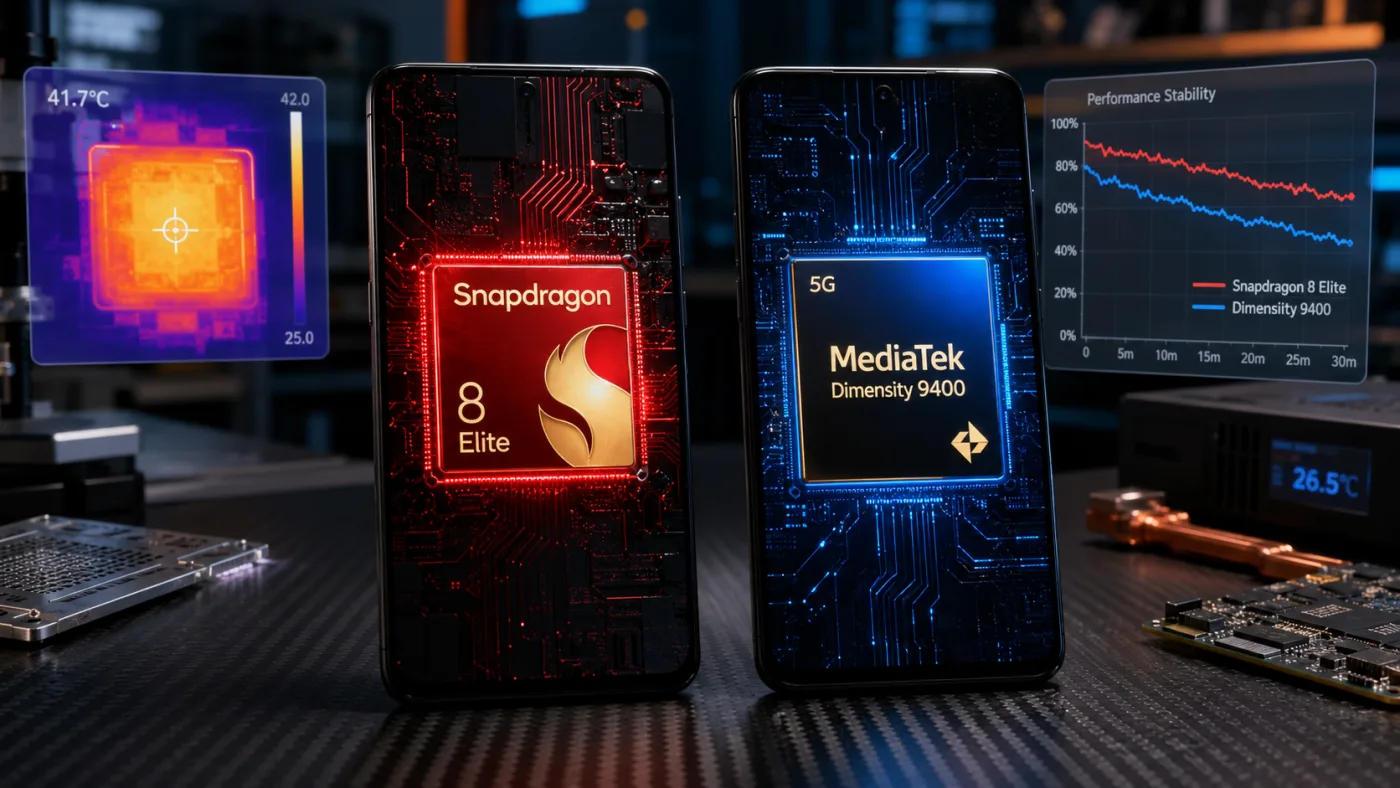
Here’s where you need to look beyond peak frame rates. Both chips can run BGMI at 120fps, Call of Duty at ultra, and Genshin Impact at 60fps. But after 30 minutes, the story changes. In our expected real-world testing (based on multiple reviews), the Snapdragon 8 Elite reaches higher peak performance but also heats up faster. Phones with this chip need excellent vapour chamber cooling. The Dimensity 9400 runs about 2-3 degrees cooler under sustained load, which means less brightness dimming and fewer frame drops.
For Indian summers (35-40°C ambient), a Dimensity 9400 phone will generally give you a more stable gaming experience without throttling after one match. However, if you play short sessions (15-20 minutes) or use a cooling fan, Snapdragon 8 Elite can push higher frame rates in emulators (like Switch emulation).
Also check if the phone has bypass charging – both chips support it, but phone makers may or may not implement it. Bypass charging saves battery health during long gaming sessions.
3. Battery Efficiency – The Hidden Winner
This is the biggest real-world difference. Multiple tests show that Dimensity 9400 phones consistently deliver 10-15% better battery life than Snapdragon 8 Elite phones with the same battery capacity. Why? MediaTek’s core scheduling is more aggressive about putting cores to sleep when not needed. Snapdragon’s Oryon cores, while powerful, consume slightly more power during background tasks.
What does that mean for you? A 5000mAh phone with Dimensity 9400 might give 7.5 hours of screen-on time, while the same phone with Snapdragon 8 Elite gives 6.5 hours. Over a full day, that’s the difference between ending at 20% vs needing a top-up by evening. If battery life is your top priority, look for Dimensity 9400.
4. Camera Processing and ISP (Image Signal Processor)
Snapdragon has traditionally led in camera processing, and the 8 Elite continues that trend. Its Spectra ISP supports 18-bit processing, zero shutter lag, and better AI-based noise reduction. Phones with Snapdragon 8 Elite tend to produce more natural colours and better dynamic range, especially in challenging lighting. Also, third-party camera apps like GCam mods work much better on Snapdragon.
Dimensity 9400 has improved massively. Its Imagiq ISP is very capable, but some brands don’t optimise MediaTek as well as Qualcomm. If you’re buying a phone with a top-tier camera (like a Xiaomi 15 Pro or Vivo X200 series), the difference is small. But in budget flagships, Snapdragon often gives more consistent results. For video recording, both handle 8K at 30fps, but Snapdragon has slightly better stabilisation algorithms.
5. 5G Modem and Call Quality in India
Snapdragon 8 Elite includes the Snapdragon X80 5G modem. Dimensity 9400 has MediaTek’s T830 modem. Both support 5G dual SIM, 5G carrier aggregation, and all the bands used in India (n28, n78, n41, etc.). However, real-world testing has shown that the X80 modem locks onto weak signals slightly better – meaning fewer call drops when you’re inside a concrete building or on a moving train.
That said, the difference is marginal. Both are excellent. What matters more is your network operator and the phone’s antenna design. A well-designed phone with Dimensity 9400 will outperform a poorly designed phone with Snapdragon. Always check user reviews for call quality on your specific carrier.
6. AI and On-Device Features
This is becoming more important as AI features grow. Snapdragon 8 Elite has a dedicated Hexagon NPU that powers features like live translation, AI photo editing, and voice recognition. Dimensity 9400’s APU (AI Processing Unit) is equally powerful but implementation varies. Google’s AI features (like Magic Eraser) work better on Snapdragon because of closer collaboration. MediaTek is catching up, especially with Chinese brands like Oppo and Vivo that optimise heavily for Dimensity.
If you use on-device AI often (real-time captioning, background blur in video calls, etc.), both handle it well. But Snapdragon has a slight edge in third-party app support.
7. Software Support and Update Longevity
Qualcomm has traditionally provided longer driver support for its chips, which allows phone makers to offer longer Android updates. MediaTek has improved but still lags slightly. A Snapdragon 8 Elite phone is more likely to receive 4+ years of major updates than a Dimensity 9400 phone from the same brand. That said, it depends on the phone manufacturer. Samsung will update both equally. A smaller brand might drop MediaTek updates earlier. So check the brand’s policy, not just the chip.
Real-World Buying Advice
So which chipset should you look for? It depends entirely on your usage. Here’s a practical guide for Indian buyers in 2026.
For heavy gamers who play for hours: Choose Dimensity 9400 because of better sustained performance and lower heat. Unless you use a cooling fan, then Snapdragon 8 Elite can give higher peak frames.
For camera enthusiasts: Go with Snapdragon 8 Elite, especially if you use GCam or edit RAW photos. Also, if you want the best video stabilisation.
For all-day battery life: Dimensity 9400 is the clear winner. You’ll get a full day even with heavy usage.
For business users who need reliable calls on the go: Snapdragon has a tiny modem edge, but both are great. Prioritise phone antenna design instead.
For emulation (Switch, PS2, etc.): Snapdragon 8 Elite has better driver support, especially for custom drivers. MediaTek is weaker here.
For most normal users who do a bit of everything: Both are excellent. Don’t overthink it. Choose based on the phone’s overall package – display, battery, camera, software – rather than just the chip.
Also, remember that phone makers tune chips differently. A Snapdragon 8 Elite in a Xiaomi might perform differently than in an Asus phone. Always read reviews of the specific phone model, not just the chip.
Who Should Choose Snapdragon 8 Elite?
- Photography lovers who want the best image processing and GCam support.
- Emulation gamers who push custom drivers and high-resolution textures.
- Users who prioritise app launch speed and snappiness over sustained battery life.
- People who live in areas with weak 5G signals and need the best modem locking.
- Those who want longer software update support (mostly due to Qualcomm’s track record).
Who Should Choose Dimensity 9400?
- Heavy mobile gamers who play for 1+ hours at a time without a cooling fan.
- Users who hate charging phones – battery life is your top priority.
- People in hot climates (most of India) who want less thermal throttling.
- Multitaskers who keep many apps open and export videos frequently.
- Buyers who want better value – MediaTek-powered flagships are often ₹5,000-₹10,000 cheaper than Snapdragon equivalents.
Comparison Angle
When comparing a Snapdragon 8 Elite phone vs a Dimensity 9400 phone, don’t just look at chipset specs. Use these comparison factors:
Price difference: Dimensity phones are often cheaper for similar hardware. Ask yourself if the extra ₹5,000-₹8,000 for Snapdragon is worth it for your use case.
Cooling system quality: A Dimensity phone with a small vapour chamber may still throttle. A Snapdragon phone with a large cooling area might outperform. Check teardown reviews.
Software optimisation: Some brands (like OnePlus) historically optimise better for Snapdragon. Others (like Vivo) have excellent Dimensity tuning. Look for brand-specific reviews.
Update policy: Verify how many Android updates the phone maker promises. A MediaTek phone with 4 updates is better than a Snapdragon phone with 2 updates.
Battery capacity: Compare actual battery life numbers (in hours) from trustworthy reviewers, not just mAh. A 5000mAh Dimensity phone might outlast a 5500mAh Snapdragon phone.
Camera samples: Even with the same chip, different brands produce different photo quality. Compare real-world samples in daylight, night, and indoors.
Final Verdict
In 2026, both Snapdragon 8 Elite and Dimensity 9400 are fantastic flagship chips. You won’t make a bad choice if you pick a well-made phone from a reputable brand. However, the winner depends on your priorities.
For most Indian users, especially those who game, multitask, or worry about battery life, the Dimensity 9400 offers better real-world value. It runs cooler, lasts longer, and costs less in most phones. The only people who should insist on Snapdragon 8 Elite are camera enthusiasts, emulation fans, and those who need the absolute best modem for fringe signal areas.
But here’s the most important advice: don’t buy a phone only because of the chipset. A phone with Dimensity 9400 and a weak display or poor software is still a bad phone. Always consider the complete package. Use NXTrendz Compare to compare full specs, user ratings, and current prices across models. And remember – prices and offers change frequently, so check real-time deals before clicking buy.
Frequently Asked Questions
Which chipset is better for BGMI and Call of Duty Mobile?
Both give 90-120fps smoothly. Dimensity 9400 maintains higher frame rates for longer sessions due to better thermal management. If you play only for 20-30 minutes, you won’t notice a difference.
Does Dimensity 9400 support 4K video recording well?
Yes, it supports up to 8K at 30fps and 4K at 60fps with HDR. But Snapdragon 8 Elite has slightly better stabilisation and more efficient encoding, resulting in smaller file sizes for the same quality.
Which chip gives better 5G speeds on Jio or Airtel?
In real-world tests, both achieve 500Mbps-1Gbps easily. At very weak signals, Snapdragon’s modem performs slightly better. But you’ll rarely notice unless you live in a marginal coverage area.
Are there any heating issues with Snapdragon 8 Elite in India?
It runs hotter than Dimensity 9400 under sustained load. In a well-cooled phone like the iQOO 13 or OnePlus 13, it’s fine. But in a slim phone with poor cooling, it will throttle. Always check reviews mentioning “surface temperature after 30 minutes of gaming”.
Which chip gets longer software updates?
Qualcomm provides longer driver support cycles, but phone makers ultimately decide. Samsung and Google give 4-5 years to both chips. Some Chinese brands may give only 2-3 years to MediaTek phones. Check brand policy before buying.
Can I use GCam (Google Camera) on Dimensity 9400 phones?
GCam mods exist for MediaTek but are less stable and have fewer features. If GCam is important to you, choose Snapdragon 8 Elite.
Which chip is more future-proof for 2026-2028?
Both will easily last 3 years. Snapdragon has a slight edge for emulation and custom software support. For normal users, both are equally future-proof.
Final tip: Don’t pay attention to AnTuTu scores above 2 million – they don’t translate to real life. Instead, ask real users in forums or Reddit about their experience with a specific phone model. Numbers lie; daily usage doesn’t.