You have saved up over a lakh rupees. You want a phone that feels fast for three years, takes stunning photos, and doesn’t leave you frustrated. But walking into a store or opening Amazon shows you a wall of options – iPhone, Samsung Galaxy S series, OnePlus, Google Pixel, and more. Each claims to be the best flagship phone 2026 has to offer.
Here is the truth: not every premium phone is right for you. Many flagship features sound great on paper but fail in daily use. Some overheat. Some have average battery life. Others take great photos indoors but struggle in low light.
This flagship phone buying guide will help you cut through the marketing. You will learn exactly what to check – from real camera performance to gaming thermals, display quality to update policy. By the end, you will know which premium smartphone fits your life and which to avoid.
Why This Matters More in 2026 Than Ever
Flagship phones now cost as much as a good laptop plus a tablet. The iPhone Pro Max and Samsung Galaxy Ultra models regularly cross ₹1,50,000. Even “value flagships” like OnePlus and Pixel sit above ₹80,000. At these prices, a wrong decision hurts your pocket and your daily experience.
Manufacturers also complicate things. Some years, the camera improvement is huge. Other years, it is just software tricks. Battery technology changed with silicon‑carbon batteries. Processors are getting more powerful but also hotter. So a smartphone comparison 2026 must look deeper than spec sheets.
1. Real‑World Performance vs Benchmark Scores
Every flagship uses a top chip – Snapdragon 8 Gen 4, Apple A18 Pro, or Dimensity 9500. All are fast. But benchmarks do not tell you about overheating or throttling after ten minutes of gaming.
What to actually check:
- Thermal management: Search for “overheating issue” plus the phone model on Reddit or X.
- Sustained performance: Look for videos showing 30 minutes of Genshin Impact or BGMI. See if the screen dims or frame rates drop.
- Daily smoothness: Flagships should never stutter while switching apps. If reviews mention lag, skip it.
For example, some Snapdragon 8 Gen 4 phones run cool while others get uncomfortably warm. The difference is the cooling system and software tuning. Do not assume the chip alone guarantees a great gaming or multitasking experience.
2. Camera: Megapixels Lie – Check These Instead
“200MP camera!” sounds impressive. But most flagship phones shoot at 12MP or 16MP by default using pixel binning. What really matters is the processing, lens quality, and stability.
Key camera checks before buying any best camera phone:
- Low‑light performance: Ask for sample photos taken at night without a tripod.
- Zoom quality: Optical zoom (periscope) is great. Anything beyond 5x optical starts losing detail.
- Video stabilisation: Check if walking videos look smooth or shaky. iPhone and Pixel still lead here.
- Portrait edge detection: Zoom into hair and glasses. Cheap processing blurs edges.
In 2026, the best camera phones are not always the most expensive. Google Pixel’s computational photography often beats Samsung in point‑and‑shoot consistency. iPhones give the most natural skin tones. OnePlus has improved dramatically but still trails in very low light.
Pro tip: Do not trust marketing samples. Watch two or three real camera reviews from different YouTubers who shoot in ordinary conditions – cloudy days, neon signs at night, moving kids and pets.
3. Display: Refresh Rate is Not Everything
Almost every flagship offers 120Hz refresh rate. But brightness, outdoor visibility, and touch response vary widely.
What to prioritise:
- Peak brightness: At least 1600 nits for comfortable outdoor use under Indian sun.
- PWM dimming: If you get eye strain or headaches, look for phones with high‑frequency PWM (above 1920Hz) or DC dimming.
- LTPO technology: This allows the screen to drop to 1Hz when idle, saving battery. Most flagships have it, but budget flagships often skip it.
Also check auto‑brightness behaviour. Some phones dim too aggressively in sunlight or brighten too slowly. That becomes annoying daily.
4. Battery Life and Charging: The Hidden Trade‑Off
Big number on paper does not mean all‑day battery. A 5000mAh battery with an inefficient processor and 2K screen can die faster than a 4500mAh phone with a power‑efficient chip.
New in 2026: Silicon‑carbon batteries allow higher capacity in the same size. Some flagships now offer 5500mAh or even 6000mAh without being bulky. However, fast charging speeds have plateaued – 65W to 100W is plenty. Anything above 100W gives diminishing returns and may reduce battery lifespan.
Real questions to ask:
- Does the phone last a full day of heavy use (5+ hours screen time, camera, gaming)?
- Does it support wireless charging? (Convenient for desks and cars)
- Is a charger included in the box? Many brands removed it. Factor that cost.
Before buying, compare live prices, warranty, seller rating and available offers. Use the comparison table and retailer links to check the latest deal.
5. Software Updates and Longevity
A ₹1 lakh phone should last at least four years. But not all brands support that long. Samsung and Google now offer 7 years of OS updates. OnePlus offers 4 years. Apple supports iPhones for 5‑6 years.
Do not ignore update policy. Some flagships receive only two Android version updates. You will feel left behind within two years.
Also check update speed. Samsung and Google push Android updates within weeks. Others may take months. If you care about security patches and new features, this matters a lot.
6. Gaming Performance – For Mobile Gamers Only
If you play BGMI, Call of Duty, or Genshin Impact daily, not every flagship is a best gaming phone. Gaming requires sustained performance, good cooling, and responsive touch sampling.
What serious gamers should check:
- Frame rate stability over 30 minutes (watch thermal tests on YouTube).
- Touch sampling rate (higher = faster response in competitive games).
- Shoulder trigger buttons – some flagships have virtual or physical triggers.
- Game mode features: call blocking, do not disturb, performance tuning.
Phones like the ROG Phone and iQOO flagships still outperform mainstream iPhones and Galaxies in long gaming sessions because they have better cooling and gamer‑centric software. But they compromise on camera or water resistance.
Verdict for gamers: If gaming is your top priority, consider a dedicated gaming flagship. If you game occasionally, any flagship with a Snapdragon 8 Gen 4 or A18 Pro will be fine.
7. Brand Ecosystem and Resale Value
Do you own a Mac or iPad? iPhone makes more sense. Samsung tablet and Galaxy Buds? Galaxy S series fits perfectly. OnePlus? Their ecosystem (watch, buds, tablet) is growing but still limited.
Resale value: iPhones hold value best in India. You can sell a two‑year‑old iPhone for 50‑60% of its price. Samsung Galaxy S series comes second. OnePlus and Pixel drop faster.
If you upgrade every two years, factor in resale value. Paying ₹1,20,000 for an iPhone might actually cost you less over time than a ₹90,000 OnePlus that sells for much less later.
Practical Checklist Before Clicking “Buy”
- Set a budget: Flagship range is wide (₹70k to ₹1.8L). Decide exact limit.
- List your top 3 uses: Camera? Gaming? Battery? All‑rounder?
- Watch 3 different review channels – not just one.
- Visit a store to hold the phone. Weight, grip, and button placement matter.
- Check return policy and warranty terms (including accidental damage).
- Compare exchange offers – sometimes older phone trade‑in saves ₹10‑20k.
Common Mistakes Buyers Make
- Buying based on last year’s reputation – every brand has good and bad years.
- Ignoring software updates – a great phone becomes frustrating after two years without updates.
- Overpaying for features you never use (e.g., 100x zoom, 8K video).
- Not checking real battery life under your usage pattern (heavy vs light).
- Believing “Pro” models are always better – sometimes regular Pro is enough.
Who Should Buy a Flagship Phone in 2026?
Yes, buy a flagship if:
- You use your phone 5+ hours daily for work, media, and photography.
- You want a premium feel, great display, and top‑tier camera.
- You keep phones for 3‑4 years and want smooth performance throughout.
- You are a mobile gamer or content creator.
Avoid flagship if:
- You mostly call, WhatsApp, and check email – a ₹25k mid‑range phone does that perfectly.
- You are clumsy and break phones often – flagships are expensive to repair.
- You upgrade every year – lease or EMI programs rarely make financial sense.
Final Verdict: There Is No Single “Best” Flagship
The best flagship phones 2026 for different people:
- Best overall all‑rounder: Samsung Galaxy S26 Ultra (if released) or iPhone 17 Pro Max – great cameras, battery, and software support.
- Best camera phone: Google Pixel 10 Pro – unbeatable computational photos.
- Best gaming flagship: ASUS ROG Phone 9 or iQOO 14 – best cooling and touch response.
- Best value flagship: OnePlus 13 or Xiaomi 15 – near‑flagship experience for ₹20‑30k less.
- Best for iOS ecosystem: iPhone 17 Pro – unmatched integration with Mac, iPad, Watch.
NXTrendz Compare may earn a small commission when users buy through affiliate links, but our buying advice is based on specs, usability and value.
Use the comparison table and retailer links to check the latest deal. Do not rush. A flagship phone is an investment. The right one will make you smile every day for years. The wrong one will annoy you every time it lags, dies too fast, or takes a blurry photo.
Frequently Asked Questions (FAQ)
1. Is it worth buying a flagship phone in 2026 instead of a mid‑range?
Yes if you value camera quality, display brightness, gaming performance, and longer software support. No if you only need basic tasks and want to save money. Mid‑range phones like the Nothing Phone 3 or Samsung A55 are very capable for half the price.
2. Which flagship phone has the best battery life in 2026?
Phones with silicon‑carbon batteries like the OnePlus 13 (6000mAh) and iQOO 14 lead. iPhone Pro Max and Samsung Ultra models also last a full day easily. Check real battery drain tests on YouTube – they vary by screen brightness and usage.
3. Should I wait for a price drop or buy at launch?
Flagships drop price significantly after 3‑6 months – often by ₹10‑20k. If you are not in a hurry, wait for festive sales (Diwali, Amazon Great Indian Festival). If you want the latest tech immediately, buy at launch but avoid pre‑ordering without reviews.
4. How do I compare two flagship phones properly?
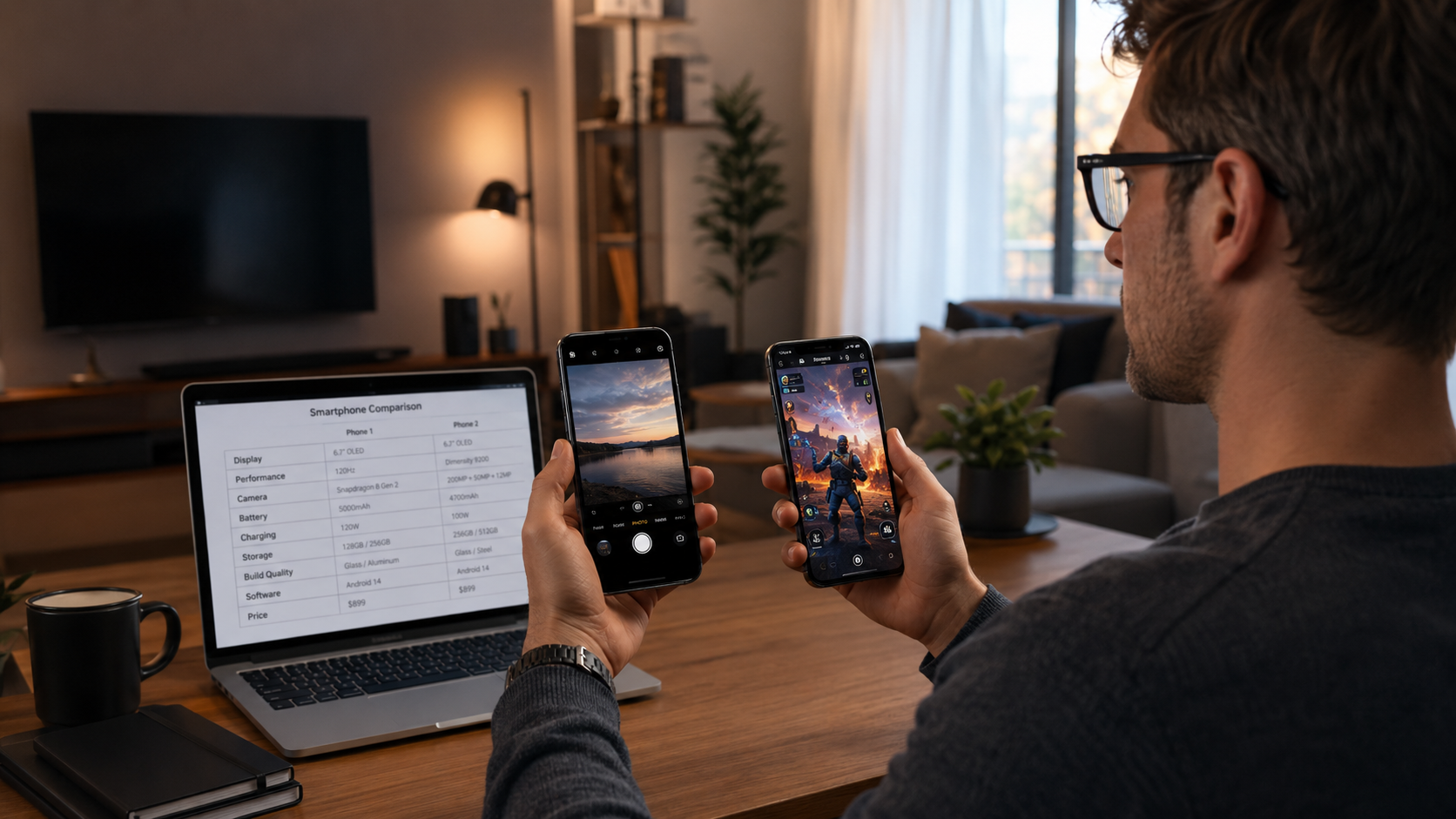
Do not rely only on spec sheets. Compare real camera samples, battery drain tests, and thermal performance. Use our smartphone comparison 2026 tools to see side‑by‑side selling points, then visit a store to handle both. One phone might feel better in hand even if specs are similar.
log post here...