Let’s be honest. The ₹30,000 price point in 2026 is the sweet spot for Indian smartphone buyers. You don’t get flagship-level everything, but you get about 85% of the premium experience at nearly half the price. Brands like OnePlus, Nothing, Samsung, Xiaomi, iQOO, and Realme fight hard here.
But here’s the problem. Every phone looks great on paper. 200MP cameras, 120Hz displays, 5000mAh batteries – numbers don’t tell the whole story. A poorly optimized 200MP camera can click worse photos than a good 50MP sensor. A 120Hz display on a weak chip can still feel laggy.
That’s why you need to know what actually matters before spending your ₹30,000. In this guide, we’ll break down exactly what to check – real performance, camera quality, battery life, software updates, and hidden compromises. No jargon. Just practical advice for Indian buyers. Prices and offers change, so always check final price, warranty, seller rating, and return policy before buying.
Quick Summary
- Under ₹30,000, focus on processor efficiency over peak clock speed – Snapdragon 7+ Gen 4 or Dimensity 8300 series are solid choices.
- Camera quality depends more on software tuning and sensor size than megapixel count. Look for OIS (Optical Image Stabilisation) if you shoot often.
- Battery life matters more than fast charging speed. A 5500mAh battery with 45W charging beats a 5000mAh with 120W for most daily users.
- Minimum 256GB storage and 8GB RAM is recommended. Avoid 128GB if you plan to keep the phone for over two years.
- Software update policy is critical – at least 3 years of Android updates and 4 years of security patches should be your baseline in 2026.
Why This Topic Matters
India’s smartphone market is flooded with options between ₹25,000 and ₹30,000. In fact, most buyers don’t need to spend ₹50,000 or more. The mid-range premium segment now offers excellent 1.5K AMOLED displays, capable cameras, and all-day battery life. But the difference between a “good buy” and a “regret buy” often comes down to small details that companies hide in fine print.
For example, a phone might advertise “67W fast charging” but ship with a 33W charger in the box. Or it might claim “flagship-level cooling” but throttle performance after 10 minutes of gaming. Indian summers make throttling even worse. Similarly, some brands promise 3 years of updates but deliver them six months late with bugs.
By the end of this article, you’ll know exactly which specifications are marketing fluff and which ones actually improve your daily experience. You’ll also learn how to compare phones side-by-side on NXTrendz Compare before clicking “buy”.
Key Features or Main Points
Before we dive into specific models, let’s understand the five pillars that define a great phone under ₹30,000 in 2026. These are what you should compare across any shortlisted device.
1. Processor and Real-World Performance
The chipset is the brain of your phone. But don’t get lost in benchmark scores. An AnTuTu score of 800,000 vs 900,000 won’t feel different while scrolling Instagram or using WhatsApp. Where it matters: gaming, multi-tasking, and long-term smoothness.
Under ₹30,000, look for chips built on 4nm or newer process nodes. Qualcomm’s Snapdragon 7+ Gen 4, Snapdragon 8s Gen 3 (if on discount), MediaTek Dimensity 8300 Ultra are top picks. Avoid older Snapdragon 8 Gen 1 phones – they run hot. Also, ensure the phone has at least a vapour chamber cooling system if you play BGMI, Call of Duty, or Genshin Impact for more than 30 minutes.
Real-world test: Open 10 apps including camera, then switch between them. Does it stutter? Also, check if the phone reduces brightness or closes background apps during gaming – that’s a sign of weak thermal management.
2. Display – Not Just Refresh Rate
Almost every phone above ₹20,000 now has a 120Hz AMOLED display. But quality varies. Look for three things: peak brightness (at least 1300 nits for outdoor visibility), resolution (1.5K is the sweet spot – 1080p is fine but 1.5K looks sharper), and touch sampling rate (360Hz or higher for gaming).
Also check if the display has flat edges or curved. Curved screens look premium but are harder to find screen protectors for, and accidental touches are common. For most Indian users, a flat 1.5K 120Hz AMOLED with Corning Gorilla Glass Victus 2 is ideal. Avoid phones with 90Hz displays at this price – that’s outdated in 2026.
HDR10+ or Dolby Vision support is a bonus if you watch Netflix or Prime Video on your phone.
3. Camera System – Megapixels Lie
Here’s where most buyers get tricked. A 108MP camera on a budget phone often produces worse photos than a 50MP camera with a large sensor and good software. Why? Because megapixels alone don’t capture light – sensor size does. Look for terms like “1/1.5-inch sensor” or “Sony IMX” series. Larger sensor = more light = better low-light photos.
Also, check for Optical Image Stabilisation (OIS). It’s a must-have if you shoot videos or take night photos. Without OIS, your 4K video will look shaky. Many phones under ₹30,000 skip OIS to cut costs. Don’t compromise on this if camera is a priority for you.
Ultrawide cameras are useful, but macro and depth sensors are mostly useless – they are just filler lenses. A good phone under ₹30,000 should have: a primary camera with OIS (50MP or 64MP), a decent ultrawide (8MP or 12MP), and a usable 2MP macro if included is fine as a bonus. Selfie camera quality varies widely – check real-world samples online.
4. Battery and Charging – The Real-World Combo
A 5000mAh battery is standard now. But a phone with 5500mAh and a power-efficient chip will easily last 1.5 days of normal use. Fast charging is nice, but above 45W, the real-world difference is small. Going from 0 to 100% in 40 minutes vs 25 minutes – most users won’t notice daily.
What matters more: charging consistency. Some phones slow down charging after 50% aggressively. Also check if the phone comes with a charger in the box – many brands have removed it. For Indian buyers, a bundled charger is still a big plus. Wireless charging is rare under ₹30,000 and not a dealbreaker.
Battery health features matter too – look for “bypass charging” for gaming (power goes directly to phone, not battery) and charge limiting to 80% to extend battery lifespan.
5. Software and Update Commitment
This is often ignored but becomes critical after 18 months of usage. In 2026, any phone above ₹25,000 should promise at least 3 major Android updates and 4 years of security patches. Brands like Samsung (4+5 years), Nothing (3+4), and Google Pixel (3+5) are good. Some Chinese brands still offer only 2 updates – avoid them if you keep phones for 2+ years.
Also consider bloatware. Xiaomi, Realme, and iQOO pre-install many apps. Samsung and Nothing have cleaner software. Google Pixel has the cleanest but weaker hardware at this price. Choose your trade-off.
Real-World Buying Advice
Now that you know what to check, here’s how to apply this knowledge when shopping for a phone under ₹30,000 in 2026.
Step 1: List your top 3 use cases. Gaming? Camera? Battery life? General daily use? No phone does everything perfectly. If you game heavily, prioritise chipset and cooling. If you take many photos, prioritise OIS and software processing. If you travel, prioritise battery and fast charging.
Step 2: Ignore launch prices. Phones frequently drop ₹2,000-₹5,000 within 2-3 months during sales on Flipkart or Amazon. Use price tracking tools. The “real” value often appears during Big Billion Days or Great Indian Festival. But if you need a phone now, look for bank offers – many phones have effective prices under ₹27,000 after discounts.
Step 3: Read recent user reviews, not just tech reviewers. Tech YouTubers use phones for a week. Real users live with them for months. Look for complaints about heating, battery drain after updates, or green tint issues. Also check service centre availability in your city – some brands have poor after-sales support in tier-2 and tier-3 cities.
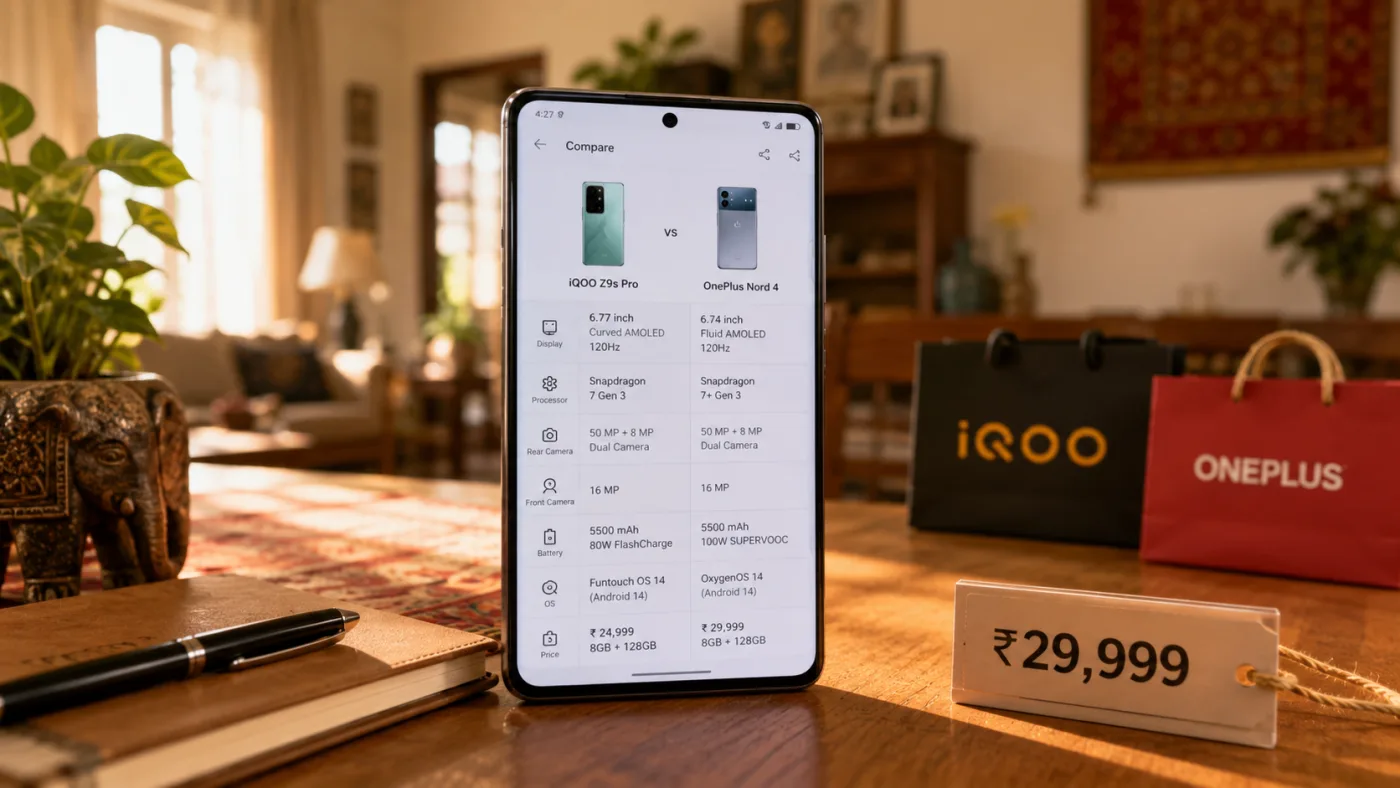
Step 4: Compare side-by-side on NXTrendz Compare. Use our comparison tool to see price, specs, and user ratings across multiple phones. Don’t rely on memory – seeing them next to each other reveals trade-offs clearly.
Step 5: Check the return policy and warranty. Flipkart and Amazon have 7-day replacement for defects but not for “change of mind”. Phones bought from brand stores usually have 14-day return. Always verify before clicking buy.
Who Should Consider This?
- Students and young professionals who want flagship-like features without spending ₹50,000.
- Users upgrading from a 3-4 year old phone under ₹20,000 – you will feel a massive difference in speed, camera, and display.
- Casual gamers who play BGMI or Call of Duty at medium settings for 1-2 hours daily.
- People who value battery life and want a phone that lasts all day with heavy use.
- Camera enthusiasts on a budget – but only if you choose a model with OIS and good software.
Who Should Avoid This?
- Hardcore mobile gamers who play at highest settings for hours – invest in a dedicated gaming phone like iQOO Neo series or ROG Phone (₹40,000+).
- Users who want the absolute best camera for professional photography – consider Google Pixel 8a or iPhone SE (wait for discounts or increase budget).
- People who need 512GB storage or 16GB RAM – rarely available under ₹30,000 except for older models.
- Those who prefer stock Android with zero bloatware – your options are limited (Nothing Phone 2a or Moto Edge series).
Comparison Angle
Before finalising any phone under ₹30,000, compare these factors side-by-side. Use our NXTrendz Compare tool to see actual numbers.
Price vs effective price: One phone may cost ₹29,999 but have no charger and no bank offer. Another phone at ₹28,999 includes a charger, has ₹2,000 cashback, and costs effectively ₹26,999. The cheaper one wins.
Performance stability: Two phones with the same chipset can perform differently. Check for “sustained performance” graphs in reviews – how much does speed drop after 20 minutes of gaming?
Camera consistency: Compare camera samples in the same lighting conditions – daylight, indoors, night. See which phone keeps skin tones natural and handles streetlights without flares.
Display outdoor visibility: Compare peak brightness numbers and whether the phone has an anti-reflective coating. Under Indian sun, 1000 nits feels very different from 1500 nits.
Battery life cycle: Compare how many hours of screen-on-time (SOT) real users report after 6 months of use. Some batteries degrade faster than others.
Warranty and service: Compare brand service centre density in your city. Samsung and Xiaomi have the widest network. Some newer brands may take 7-10 days for screen repairs.
Software update track record: Check if the brand actually delivered updates on time for older models. A promise is worthless without history.
Long-term value: A phone with better software support and durable build will feel less outdated after 2 years. Spending ₹2,000 more for an extra year of updates is worth it.
Final Verdict
The best phone under ₹30,000 in 2026 isn’t the one with the highest specs – it’s the one that matches your daily needs without frustrating compromises. For most Indian buyers, a phone with Snapdragon 7+ Gen 4 or Dimensity 8300, a 1.5K 120Hz flat AMOLED display, a primary camera with OIS, 5500mAh battery with 45W+ charging, and guaranteed 3 years of Android updates is the sweet spot.
Currently, strong contenders include the Nothing Phone (3a) for clean software, Samsung Galaxy A56 for long updates, iQOO Z10 Pro for gaming, and Realme 13 Pro+ for camera. But always check current offers – a ₹32,000 phone on sale for ₹28,999 might beat a ₹27,999 phone with no discount.
Remember: don’t rush. Use comparison tools, read real user reviews, and wait for a good bank offer. Your ₹30,000 should buy you happiness for at least three years. Choose wisely.
Frequently Asked Questions
Is 5G necessary in a phone under ₹30,000 in 2026?
Yes, absolutely. 5G is now widely available in most Indian cities and many towns. Even if you don’t use 5G today, a phone at this price should support multiple 5G bands (at least 7-8 bands) to be future-proof. Avoid 4G-only phones at this budget.
Should I buy a 1-2 year old flagship phone instead of a new mid-range phone?
Sometimes yes. An older Samsung S23 (if discounted) or OnePlus 11R can offer better build quality and cameras. But you lose on battery life, software updates (closer to end-of-life), and warranty. Only buy old flagships from trusted sellers with at least 6 months of remaining warranty. Otherwise, stick with new mid-range phones.
Which has better after-sales service in India – Xiaomi, Samsung, or Nothing?
Samsung has the widest and most reliable service network, especially in smaller cities. Xiaomi is also widespread but service quality varies by centre. Nothing is improving but still limited to metro cities. For tier-2/3 buyers, Samsung or Xiaomi are safer choices under ₹30,000.
How much RAM and storage do I really need in 2026?
For smooth multitasking, 8GB RAM is the minimum. 12GB is nice but not necessary for most users. For storage, 256GB is strongly recommended because apps, photos, and videos fill up 128GB very fast. Also, check if the phone has a microSD card slot – many have removed it. If no SD slot, do not buy 128GB version.
Does a phone under ₹30,000 support wireless charging in 2026?
Very rare. A few models like the Nothing Phone (3a) Plus might offer 15W wireless charging, but it’s not common. Don’t prioritise wireless charging at this price – wired charging is much faster and more efficient.
Which is better for photography – Google Pixel 7a or a new 2026 mid-ranger?
The Pixel 7a (often under ₹30,000 after discounts) still has excellent computational photography, especially for portraits and low light. But its battery life, charging speed, and display are outdated. New 2026 mid-rangers like Realme 13 Pro+ will beat it in battery and zoom cameras. Choose Pixel only if still photography is your only priority.
Always compare actual prices on Flipkart, Amazon, and brand stores before buying. Offers change weekly. Also check if the seller has high ratings and a genuine return policy. Never buy electronics from unknown sellers just for a lower price.